Showing posts with label diagnosis. Show all posts

Thursday, January 13, 2011

Data Mining: a very simple start for a beginner (me)

Data mining is "the process of extracting patterns from data" (wikipedia). A data miner changes data into information. Educational data mining is a process of extracting data about learners and using that data to teach better.

What sort of things can you do?

You can use data to develop categories, clusters and classifications. 
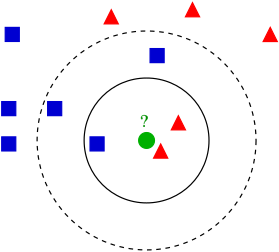
In k-Nearest Neighbour (k-NN) classification a data point is classified by majority vote of its nearest neighbours. If k=1 the green circle will be classed with the red triangles, because its nearest neighbour is a red triangle. If k=3 it will again be red triangles because the majority of the (k=)3 nearest neighbours are triangles. If k=5 it will be classified as a blue square because 3 of the (k=)5 nearest neighbours are blue squares. Clearly the choice of k is critical. An alternate method is to weight the classification by the distance to each of the nearest neighbours.


You can try to discover behaviours which occur together. For example, in the sentence: "This is the life!", there are 2xe, 1xf, 2xh etc. If we only count where there are 2 or more occurrences, the "frequent 1 sequences" are: 2xe, 2xh, 3xi, 2xs, 2xt. If we seek the 2-sequences (only for these) we have: e_, e!, hi, he, is, is, s_, s_, th, th. Using a frequency threshold of 2 again, we are left with is, s_, and th as our frequent 2 sequences. Moving to 3 sequences (again only using those we have identified as frequent 2 sequences) and another threshold of 2 we have only 1 frequent 3 sequence: is_. Moving to 4 sequences we find is_i and is_t. Neither of these pass the threshold so the algorithm stops. What have we learnt? The 1 sequences could tell us something about the commonest letters in English and the 2 sequences tell us that is and th are frequent combinations and that s often happens at the end of words. The 3 sequences tell us that is often happens at the end of words. 

So what?

We now have a predictive framework: if you get an i expect an s (and then a space), if you get an s expect a space, if you get a t expect an h.

We could use this process to create 'recommendations' a la Amazon: if you enjoyed doing those sums you might like to try these. Or diagnoses, enabling us to identify the appropriate intervention for the measured behaviour.


References

Baker, S.J.D. & Yacef, K. (2009) The State of Educational Data Mining in 2009: A Review and Future Visions: http://www.educationaldatamining.org/JEDM/images/articles/vol1/issue1/JEDMVol1Issue1_BakerYacef.pdf accessed 10th January 2011

International Working Group on Educational Data Mining available at http://educationaldatamining.org/ accessed 10th January 2011

Wikipedia Data Mining available at http://en.wikipedia.org/wiki/Data_mining accessed 10th January 2011

Wednesday, November 17, 2010

Diagnostic assessment

The 'rip, mix, burn' model of pedagogy (see post 14th November 2010) is very compelling but it fails to provide any guidance about assessment.


Edinburgh Castle
Imagine if a person phoned you up and asked you for directions to travel to Edinburgh. I might say: go the the Black Cat roundabout and turn left; continue north up the A1 until you reach Edinburgh. These instructions would be wrong for people travelling from Inverness, Glasgow, London or Cambridge. The first thing to do would be to find out where they were.

You must assess before you teach. If you don't know where a person is in their learning you can't personalise their teaching. Much of what you do teach will be wasted. Your students won't end up where you want them to. Some will get very lost indeed!

MRI scanner
In the 19th Century, medicine shook off the shackles of quackery. Doctors learnt to diagnose. They used technology (thermometers, stethoscopes, etc) to measure key indicators of health. As time moved on they developed more and more high tech diagnostics: X-ray machines, blood pressure cuffs, blood tests, MRI scanners.

By and large education retains the pencil and paper test. These give next to useless information. I attended a parents' evening where the Maths teacher was armed with a formidable array of numbers about my stepdaughters' Maths. What do the numbers mean? I asked. She wasn't very good at Maths. Which bit of Maths? I asked. Maths generally, I was told. What does she need to do to improve? I asked. Try harder and ask for help, I was told.

At least the Maths teacher had tried. Most of the teachers that evening had measured nothing and simply spoke in platitudes. I can't imagine a doctor giving me such vague replies.

So my utopian vision for the future of education is to use technology to improve our diagnostic assessment.